
When to use Micro-frontends
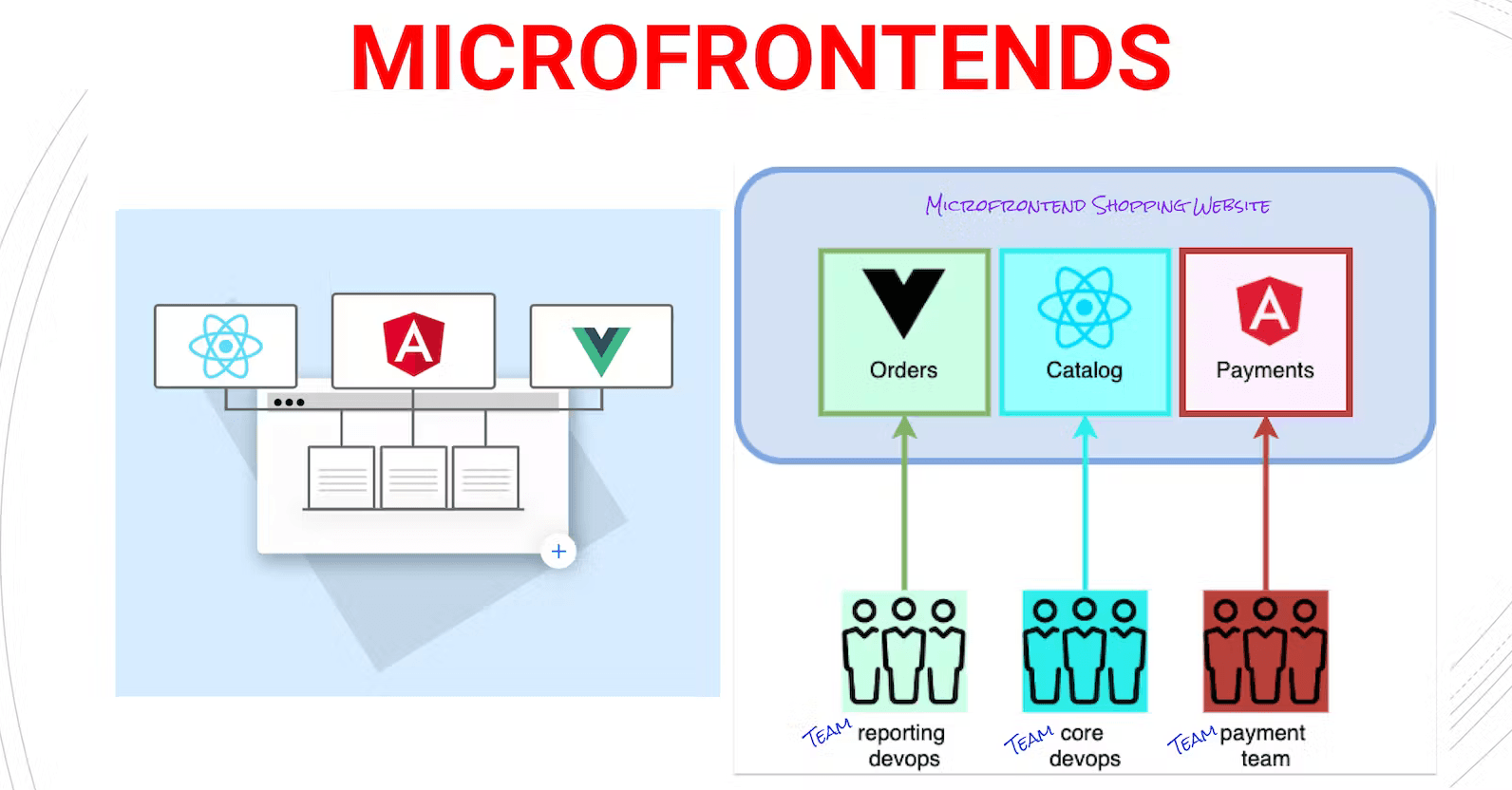
I've been working with Micro Frontends for several years now, and I believe I've accumulated enough experience to share my perspective on when they should be employed.
I believe that, for a sufficiently large team with well-organized domains, implementing separate pipelines within a monorepo structure is a reasonable design choice for maintaining independent team progress.
However, my skepticism arises from the observation that few teams find themselves in this favorable position. For those that do, my suggestion is to prioritize domain factorization before embracing a more complex architecture. The intricacies of Micro Frontends (MFEs) introduce challenges in releasing, moving, and testing code cohesively.
Instead, I propose initiating the process with a modular monolith and dedicating effort to the substantial task of refactoring domains before delving into the comparatively simpler task of establishing new pipelines.
Micro-frontends primer
Micro-frontends (MFEs) aren't a naive concept. It's widely understood that breaking down software systems into isolated components facilitates evolution. Similarly, there's no inherent reason why large front-end JavaScript apps shouldn't benefit from modularization.
Drawing parallels with microservices, originally promoted for backend scalability, the true motivation was providing teams with individual contexts to enhance scalability. This led to the emergence of micro-frontends, reflecting the intuitive advantages of microservices. Instead of a single JavaScript app in one repository with a solitary pipeline, the pattern involves splitting N apps into N repositories with N pipelines. While some opt for a monorepo setup, it's not universally adopted.
Problems with Micro-frontends
Here are the critical factors I believe contribute to challenges with Micro-frontends:
- Distributing a monolith across separate components can lead to significant difficulties.
- Splitting appears simpler, but refactoring is essential before the division can occur.
- Micro-frontends have the potential to manifest as a type of "rewrite fever."
Don't create a ditributed monolith!
Large frontend applications suitable for Micro-frontends often exhibit a high degree of interdependence, prompting MFE architectures to propose context-sharing mechanisms or state-passing techniques. This might involve JavaScript bundles exposing global functions or using postMessage as an event bus. However, as more state is shared, and dependencies increase, true isolation becomes harder to achieve.
This presents a challenge compared to interdependencies within a monolith, where refactoring is straightforward. Within a monolith, dependencies can be removed or modified in a single commit, and understanding them involves examining a single repository. TypeScript can ensure that changes are well-managed, and a single test pipeline can verify modifications.
However, Micro-frontends can incur overhead if not approached intelligently. Deployment may require careful orchestration across multiple locations, shared code may face challenges with versioning, and integration testing becomes more complex. Engineers may need to navigate multiple repositories to comprehend the entire system, leading to an impractical developer experience.
In my perspective on Micro-frontends, when they are employed, it is crucial to meticulously assess and minimize dependencies. However, reducing dependencies is challenging when dealing with tightly-coupled code, as discussed in the next point.
Refactor before splitting
Imagine our frontend app as a tangled web of interdependencies, resembling a hairball. The question arises: how do we untangle this complexity? Engineers, and even managers, often get so excited about moving away from the monolith that they overlook the crucial intermediate step of disentangling the hairball.
One might be tempted to defer decoupling, thinking it can be addressed during the migration process. However, this approach is problematic. It leads to a state where some code is migrated, but the remaining portion remains tightly coupled. It's more effective to minimize the scope of each incremental change, avoiding the attempt to merge refactoring and replatforming into a single mission.
The rewrite fever
At times, engineers (and managers) become so frustrated with a subpar codebase that they daydream about scrapping it entirely. In microfrontend projects, teams may consider using Micro Frontends (MFEs) as a means to essentially rewrite the codebase from scratch, sidestepping the complexities of the original project.
However, rewrites pose significant risks. The allure lies in the perception that writing code is easier than deciphering existing code. Developers may believe that, armed with modern tools and consolidated knowledge, they can outperform the original engineers. This may be influenced by a touch of "main character syndrome," where the last project failed because "I" didn't write it. Yet, the actual rewrite proves more intricate than anticipated, as the old code harbors hidden secrets and edge cases that weren't immediately apparent.
In MFEs, the motivation often stems from a poorly structured monolith codebase that becomes a strong temptation for rewrites. However, if you've reached this point, your pages and UI are likely too complex to be rewritten swiftly. A Product page accumulating five years of code requires substantial effort to understand and unravel. Transitioning it into a Next.js app won't expedite this process. While an incremental rewrite via MFEs is preferable to a total rewrite in a new monolith, the difference is marginal.
Modularize before going to Micro-frontends
Maintain a single repository and build initially, but begin structuring your code into packages with stringent architectural boundaries. Ensure these packages interact solely through well-defined, minimal interfaces, ideally utilizing a compact user context object with essentials like ID and tokens. While packages can share idempotent state such as API caches, avoid sharing context like Redux stores or React context.
As you divide the code, consider implementing tools like Yarn workspaces tailored for managing a monorepo. This allows actions such as separating unit tests and only running suites for the modified parts. These steps yield Micro Frontend (MFE)-like benefits without excessive overhead.
Gradually progress towards a microfrontend-like architecture within the monorepo, incorporating separate pipelines and fully differential builds over time.
Final Words
Despite the aforementioned criticism, I envision an app evolving into something akin to a microfrontend project, albeit with more control and oversight compared to the polyrepo MFEs adopted by other organizations. This transformation, however, will only occur once domain isolation and design-level refactoring are predominantly completed. At that point, the codebase parts will be adequately isolated, enabling independent work.
Avoid undertaking grand projects to implement the latest architecture trends. Instead, identify problems, address them iteratively, and refrain from skipping the essential task of meticulously separating the code into distinct units. Otherwise, you may find your challenging frontend monolith merely transformed into a distributed monolith MFE.